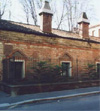
In search of the old lazzaretto following neoclassic detached houses, flamingos and eccentric Gothic architecture.
Discovering an old quarter rich in poetry and drama heritage, today still full of suggestions, a quarter steeped in architecture, science nature and commerce.
Church of San Carlo al Corso
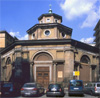
A beautiful neoclassic church built to replace the medieval church Santa Maria dei Servi, seat of the Serviti order. Planned by Carlo Amati (1832), the same architect that projected the final version of the Dome façade, the church replaces an ancient convent founded in 1290 and abolished by Napoleon in 1799. The church was consecrate to San Carlo Borromeo to celebrate the end of a devastating cholera epidemic. The restructuring (between 1814 and 1847) gave to the church a circular plan and an arcade with a pronaos composed by Corinthian columns.
Casa Fontana Silvestri - Fontana Silvestri House
This palace was built on "Corso Venezia" in the XII century and renewed with its Gothic-Renaissance cross style at the end of the XIV century. It is one of the few Renaissance places still existing in Milan; this palace was the residence of the near Porta Orientale guardian, the city gate was demolished in the XIX century.
Palazzo Castiglioni - Castiglioni’s Palace
Built by Giuseppe Sommaruga between 1901 and 1904 this palace represents a sort of manifesto of the Art Nouveau style, known also as Liberty or Floréal style. It is a three-storied palace with two façades, the first on the street and the second on the garden; there are also detached parts of the house such as stables and storage. The basement is a rough ashlar-work which represents a continuum of the natural rocky formation. The other decorations resemble the 18th century stucco style.
Palazzo Serbelloni - Serbelloni’s Palace
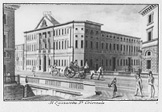
This majestic palace is today the seat of the Circolo della Stampa (Press Club or Circle); the original 15th century constitution was enriched with neoclassic motifs at the end of the XVIII century by Simone Cantoni. In the centre of the three order windows façade, there is a loggia surmounted by a tympanum based on columns and pillars.
Casa Berri Meregalli - Berri Maregalli House
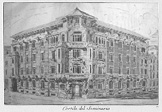
Built between 1911 and 1914 following the project of Giulio Ulisse Arata, this palace is an example of late Art Nouveau style with a mix of different styles such as Gothic, Romanic and Renaissance. This house is a masterpiece of decorations and original solutions, like the asymmetrical disposition of volumes of the façades. Different materials such as stones, terracotta and wrought iron were used to give magnificence to this building. Berri Maregalli house is also decorated with sculptures paintings and polychrome mosaics. A mysterious sculpture by Adolfo Wildt gives a gloomy aura to the main entrance.
Belgiojoso Bonaparte Villa
Built in "contrada" Porta Orientale (today Porta Venezia) between 1790 and 1796 the Villa was commissioned by Ludovico Barbiano di Belgiojoso to Giuseppe Piermarini who passed the work to his pupil Leopoldo Pollack. The style is neoclassic, with a central body and two lateral wings enriched with bas-reliefs and mythological saga statues realized under Giuseppe Parini’s indications. In 1801 it was the residence of Gioacchino Murat and his wife Carolina Bonaparte and later became the residence of the Viceroy Eugenio Beauharnais and his wife Augusta Amalia di Baviera. Eugenio Beauharnais commissioned to Andrea Appiani the fresco representing Paranaso (or Apollo) bard surrounded by the nine Muses, one of the most important masterpieces of the neoclassical Milan culture. Other eminent residences of this Villa were general Radetsky and Napoleone III. After the Unification of Italy this Villa was designated to house the contemporary art collection of the city. Nowadays the Villa is home to the Nineteenth Century Museum.
Venezia city Gate Gardens
These are the first public gardens of the city of Milan, realized between 1782 and 1786 by Giuseppe Piermarini’s project (the east area). These Italian style gardens were realized in continuity with the already existent "Boschetti" of Marina Street. The Museum of Natural History was built between 1888 and 1893 and afterwards the Planetarium "Ulrico Hoepli" (1930). The west area as far as Manin Street was built by Giuseppe Balzaretto between 1856 and 1862, following the new English landscape garden vogue.
Venezia city Gate Milan
This is one of most ancient city gates of Milan and known, until 1860, as Porta Orientale or Renza city gate because through this city gate it was possible to reach Argentium (today known with the name of Gorgonzola); it was also possible to reach Monza, Bergamo and the east Brianza. This city gate was restored in 1782 by Giuseppe Piermarini with a neoclassic style.
Casa Galimberti e Casa Guazzoni - Galimberti and Guazzoni Houses
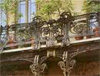
These are the most beautiful Art Nouveau style palaces in Milan, built in the XX century by G.B. Bossi. The peculiarities of these houses are the façades realized with enamel tiles which reproduce trees, flowers and female figures; the façades are enriched with wrought iron balconies.
Church of San Carlo al Lazzaretto
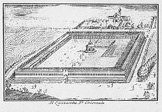
Built by Pellegrini between 1558 and 1592 on the small shrine of Santa Maria della Sanità, this church is part of the "Lazzaretto" complex. The original project consisted of a wide arcade court connecting the patient’s rooms, which were disposed around the square perimeter. An efficient system of drains and sewers was built to reduce the spreading of the disease. The church was built by Lazzaro Palazzi (1488-1513) according to Ludovico il Moro’s wishes; the plan consisted of a Chapel open on its sides and placed in the middle of the court to make it visible from all the cells.
Lazzaretto
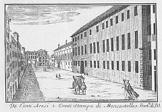
This vast complex was built by the architect Lazzaro Palazzi in collaboration with his brother in law Amadeo. The "Lazzaretto" is one of the first architectural attempts to concentrate in the same complex all the medical activities, as suggested in a documentation written by the engineer Elia Reina in 1468. The construction of the Lazzaretto was possible thanks to the commitment of Lazzaro Cairati a philanthropist and a well known notary in Milan. At the end of the great Black Death of 1486 a new "Lazzaretto" was build as per Galeotto Bevilacqua’s will, which left all his possession to the Ospedale Maggiore. The Lazzaretto was demolished in the XIX century as the result of the increasing requests for building lots. A few numbers of cells still remains in the area of Buenos Aires Avenue.
|